Congress, in the explanatory statement to its 2026 appropriations law, told the SBA to publish a list of every time a state or a tribe asked it to declare a disaster. The fiscal 2026 version landed in the Federal Register on September 14, 2026, current as of August 31. It’s two pages long, and it’s one of the most boring documents the agency will put out all year.
It’s also kind of remarkable, because the approval column says the same word 59 times in a row.
What the list actually says
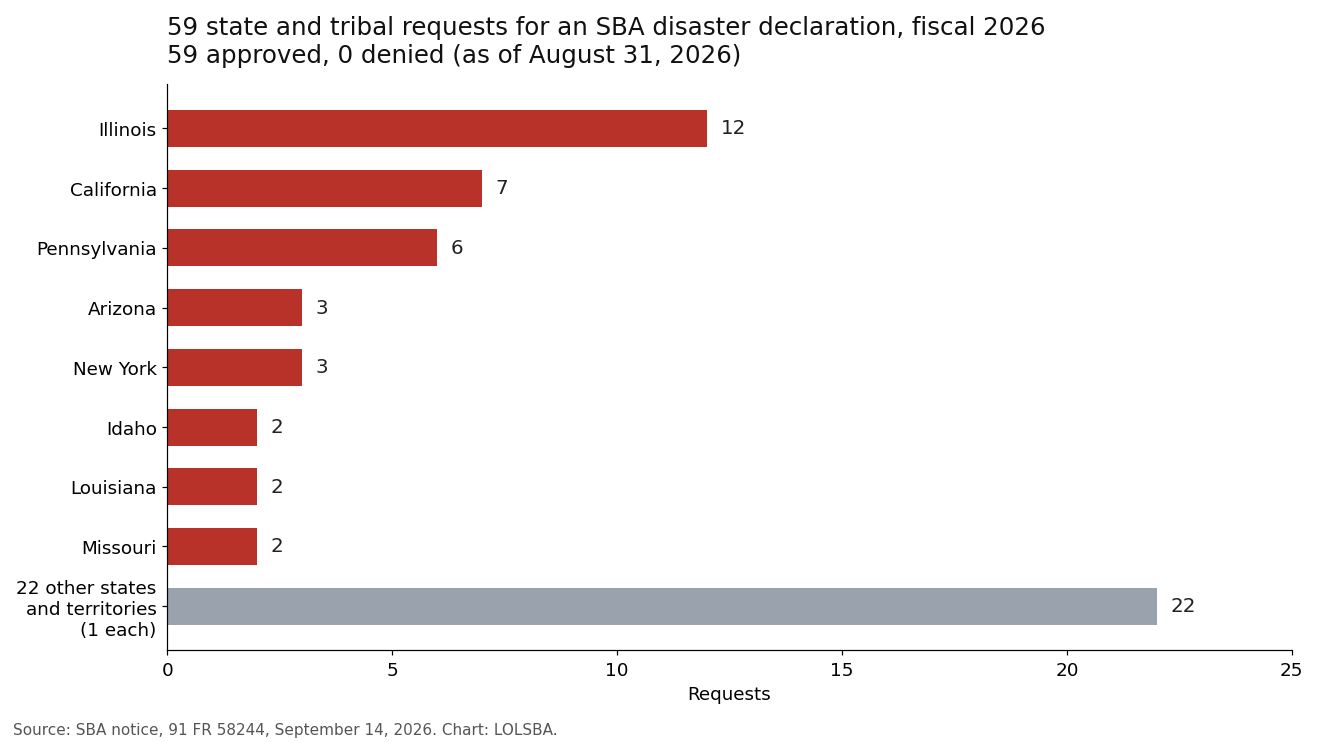
The notice covers requests made to the SBA in fiscal 2026, which started October 1, 2025. There are 59 requests on it. The approval status column reads “Approved” for all 59. There isn’t a denial, a withdrawal or a pending entry anywhere on the page.
Here’s where they came from:
- Illinois: 12 requests, roughly one in five on the whole list
- California: 7
- Pennsylvania: 6
- Arizona and New York: 3 each
- Idaho, Louisiana and Missouri: 2 each
- 22 other states and territories: 1 each, from Alaska to the Commonwealth of the Northern Mariana Islands
The disasters run the full range. Tornadoes, wildfires, blizzards, a remnant hurricane, Super Typhoon Bavi. But a lot of these aren’t the kind of disaster you’d see on the national news. There’s the Red Hook five alarm fire in New York, the Downtown Hilo Fire in Hawaii, the Louisville airplane crash in Kentucky, a twelve alarm warehouse fire in New Jersey, a hazmat incident in Garden Grove, California, and an algal bloom that contaminated water in Illinois. Several entries are apartment fires.
That isn’t a knock on those requests. A fire that wipes out a block of storefronts is a disaster for the people who own them. It just tells you what this list is: the events where a state or tribe went straight to the SBA and asked it to act.
The SBA is fast. The states are not.
We lined up the date each request reached the SBA against the date the SBA declared the disaster. The median gap is two days. 39 of the 59 were declared within three days. Three were approved the same day they came in: Florida on November 7, 2025, Oklahoma on May 1, 2026 and Kansas on August 21, 2026. The slowest SBA turnaround on the whole list was 15 days, for Tennessee and Arkansas.
For an agency this site spends a lot of time yelling at, that’s a genuinely quick rubber stamp.
The waiting happens before the paperwork reaches Washington. SBA’s own regulation, 13 CFR 123.3, says a governor’s request for a physical disaster declaration “should be delivered” within 60 days of the disaster. A governor’s certification for an economic injury declaration gets 120 days. The list doesn’t say which kind each request was, so we measured against the looser 120 day mark and counted from the last day of each disaster, the most generous way to read it. These still blew past it:
- Illinois, severe storms and flash flooding that ended July 28, 2025. Request sent April 22, 2026. That’s 268 days later.
- Illinois again, storms and straight line winds that ended August 19, 2025. Request sent March 12, 2026, 205 days later.
- Mescalero Apache Tribe, New Mexico, storms, flooding and landslides that ended August 5, 2025. Request sent February 17, 2026, 196 days later.
- Alaska, the remnants of Typhoon Halong, which ended October 13, 2025. Request sent April 13, 2026, 182 days later.
- Idaho, straight line winds that ended December 18, 2025. Request sent June 3, 2026, 167 days later.
- Idaho again, storms, flooding and mudslides that ended March 15, 2026. Request sent August 21, 2026, 159 days later.
- Nebraska, wildfires that ended April 2, 2026. Request sent August 12, 2026, 132 days later. The SBA declared it two days after that.
- Hawaii, the Downtown Hilo Fire on November 30, 2025. Request sent April 1, 2026, 122 days later.
- Missouri, storms, tornadoes and flooding that ended April 28, 2026. Request sent August 27, 2026, 121 days later.
All nine were approved. The regulation says “should,” not “must,” and the SBA clearly reads it that way.
Why the lag matters more than the approval
Think about who’s actually waiting. A disaster loan is supposed to keep a small business alive between the storm and the insurance check. If the owner of a flooded shop outside Chicago had to wait until April 2026 for the state to ask about a July 2025 storm, the SBA’s two day turnaround didn’t help much. By then that owner has either found the money somewhere else or run out of time.
And there’s a second pattern tucked inside the table. Some disasters show up twice. Missouri’s April 23 to 28 storms were requested on July 14 and again on August 27, both approved. Louisiana’s January winter storm appears with requests on January 30 and April 2. California’s late December 2025 storms appear with requests on January 28 and January 30. The notice doesn’t explain the repeats, and they could easily be separate counties or a second declaration type. But if you’re a business owner in the second batch, you waited weeks or months longer than your neighbor for the same storm.
What a 59 for 59 record tells you
A perfect approval rate can mean two different things. It can mean states only send in requests they know will clear. Or it can mean the review isn’t really a filter. The list can’t tell you which, and the SBA doesn’t say.
What the list does tell you is where to point the complaint. The federal gate here swings open in about two days. If your area shows up on this list months after the storm, the delay wasn’t sitting on a desk in the SBA’s Office of Disaster Recovery and Resilience. It was the request that hadn’t been sent yet.
Fiscal 2026 ends September 30. The next list will show whether anybody got faster.