Every week the SBA drops a handful of disaster notices into the Federal Register, and every week almost nobody reads them. They’re form letters. Same contact block, same interest rate table, same authority line at the bottom.
We read the three that went out between September 14 and September 17, 2026. Nevada, Texas and Utah. Same form, same office, same signature from James Stallings, Associate Administrator for the Office of Disaster Recovery and Resilience.
Same form. Very different clocks.
The three notices
- Nevada, Bug and Hawk Fires. Incident period August 8 through September 9, 2026. Declaration dated September 11. Primary county Washoe. Published September 17 at 91 FR 58947.
- Texas, Severe Storms and Tornadoes. Incident date August 28, 2026. Declaration dated September 10. Primary county Bexar. Published September 14 at 91 FR 58245.
- Utah, Cottonwood Fire and Flooding. Incident period June 22 through July 24, 2026. Declaration dated September 9. Primary county Beaver. Published September 14 at 91 FR 58246.
All three are administrative declarations under 13 CFR 123.3(b), the kind the SBA issues itself when a governor asks, without a presidential major disaster declaration behind it.
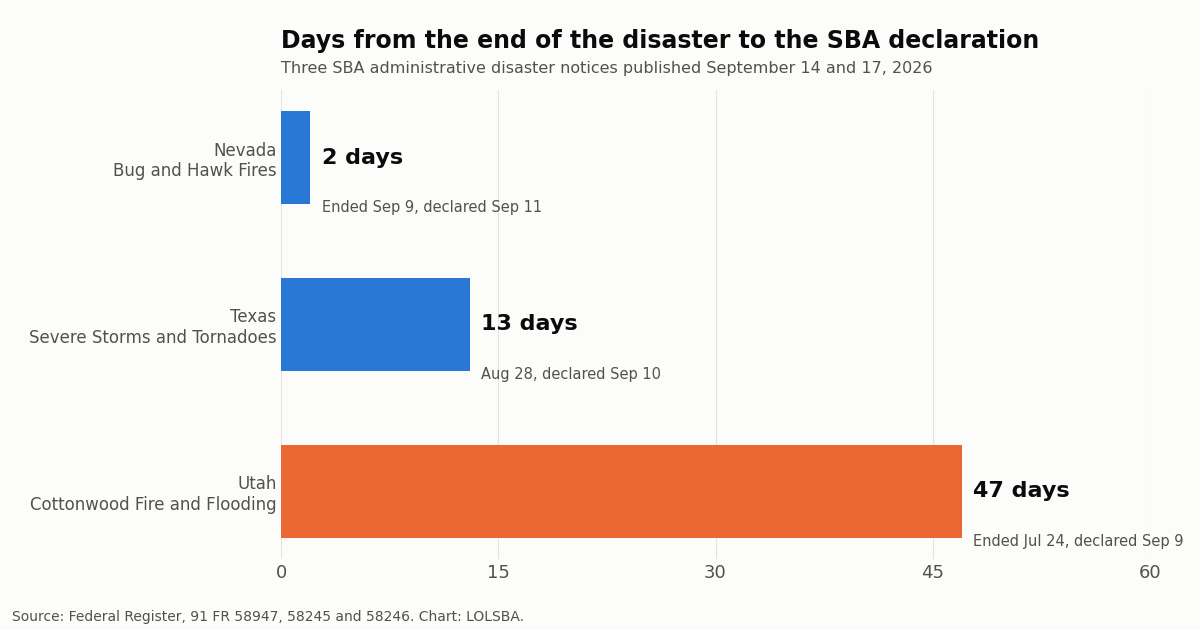
2 days, 13 days, 47 days
Count from the last day of each incident to the date on the declaration:
- Nevada: fires end September 9, declaration September 11. 2 days.
- Texas: storms on August 28, declaration September 10. 13 days.
- Utah: incident ends July 24, declaration September 9. 47 days.
The notices don’t say where those days went, and to be fair to the SBA, a lot of that gap is usually on the state side. The SBA can’t declare anything until a governor asks, and the governor’s office first has to show enough damage to qualify. When we read the agency’s fiscal 2026 request list earlier this week, the federal stamp typically came about two days after the request arrived. The long waits were the months some states took to ask.
But from the point of view of a business owner in Beaver County, the difference between who was slow doesn’t matter much. The fire and flooding ended in July. The door to an SBA disaster loan opened in September.
The deadlines are the one thing that’s fair
Here’s the part the SBA does apply evenly. The clock for applying starts on the declaration date, not the disaster date:
- Nevada: physical damage loans by November 10, 2026, economic injury loans by June 11, 2027.
- Texas: physical damage by November 9, 2026, economic injury by June 10, 2027.
- Utah: physical damage by November 9, 2026, economic injury by June 9, 2027.
So Utah didn’t lose application time to the wait. It just got the same 60 days, starting seven weeks after everybody finished bailing water.
Then somebody typed them up
These are legal notices in the official journal of the United States government. Here’s what’s printed in them.
The Utah notice heads its rate table “For Pysical Damage.” Physical, without the h. It’s the one word the whole loan category is named after.
The Texas notice says “The number assigned to this disaster for physical damage is 21859B.” Every other disaster number across the three notices is six digits: 218695 and 218700 for Nevada, 218556 and 218560 for Utah, and 218600 for the economic injury side of Texas itself. The Texas physical damage number is the only one with a letter in it. Its homeowner row is also mangled, printed as “Homeowners without Credit Available Elsewhere 3.000........” with the rate jammed into the middle of the dot leaders.
The rate tables don’t match either. Nevada and Texas give homeowners 6.000 percent with credit available elsewhere and 3.000 percent without. Utah, dated one day earlier than Texas, gives 5.750 and 2.875. Business rates (8.000 and 4.000), nonprofit rates (3.625) and economic injury rates (4.000) are identical in all three. None of the notices explains the homeowner difference.
Is any of this a scandal? No. A typo is a typo. But if you’re a homeowner in Beaver County comparing your rate to someone who lost a house in San Antonio, you’d want the notice to tell you why yours is a quarter point lower. And if you’re a loan officer keying a disaster number into a system, you’d want the number to be a number.
If you’re in one of these counties
The contiguous counties can apply too, and the list crosses state lines:
- Nevada notice: Washoe, plus Carson City, Churchill, Humboldt, Lyon, Pershing and Storey in Nevada; Lassen, Modoc, Nevada, Placer and Sierra in California; Harney and Lake in Oregon.
- Texas notice: Bexar, plus Atascosa, Bandera, Comal, Guadalupe, Kendall, Medina and Wilson.
- Utah notice: Beaver, plus Garfield, Iron, Millard, Piute and Sevier in Utah, and Lincoln in Nevada.
Applications go through the MySBA Loan Portal at lending.sba.gov. The customer service line printed in all three notices is 1 800 659 2955. Write down the deadline that applies to you, and if something on your paperwork looks off, ask. Apparently the paperwork isn’t always right.